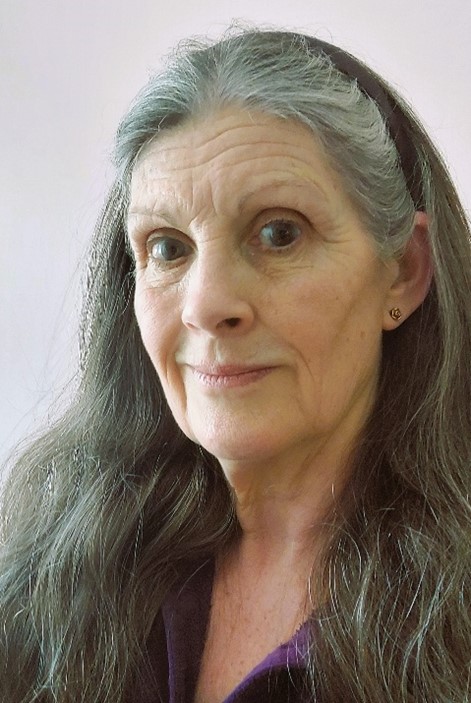
Today, I’m delighted to welcome talented writer Laura Lyndhurst to Introverted Bookworm! Laura is an accomplished author and poet, and I’m so glad she’s here with us today.
So, without further ado, moving on to my review of her latest novel:
An Honourable Institution
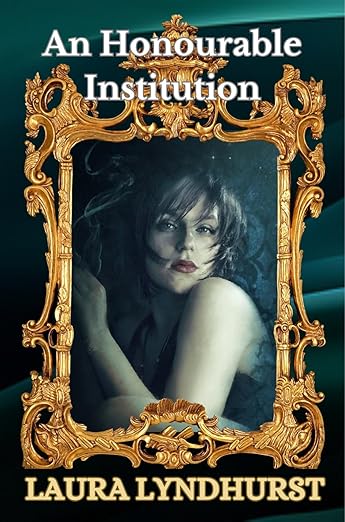
Cressida DiFerrarro is an entitled rich girl. She enjoys a free and easy lifestyle, unfettered by complications. However, when Cressida is faced with a complex moral dilemma, her choices will determine the course of her life, as well as the lives of others, too.
I love the multiple points of view taken throughout the book. As a reader, I could fully immerse myself in each character’s individual mindset and point of view. This is an edgy novel, which poses complex questions along the way, with never a dull moment in sight. Lyndhurst expertly creates memorable, razor-sharp characters. Coercion, intrigue, and touches of dark humour, run throughout the narrative. Juicy stuff! The plot is simmering with unspoken tension, which kept me engaged from start to finish. This is a fascinating, addictive book!
Social Climbing and Other Poems
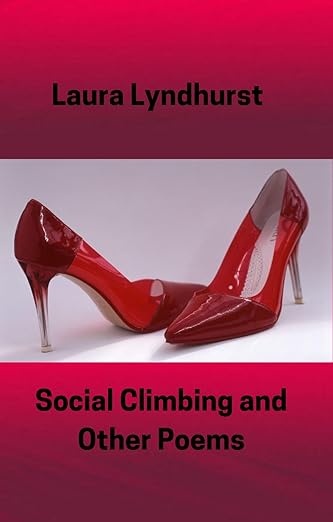
In Social Climbing and Other Poems, the poetry is written to prompts of images taken by photographer Clive Thompson.
“Cold Comfort” shows a photograph of snowdrops dusted with snow — a seemingly picturesque image, which is juxtaposed with the doomed holiday described in the poem itself: “Freezing our stamens off, rooted to the spot and paralyzed with cold.”
“Trolley Dashed” is one of my favourites, using the Covid pandemic as inspiration. There is a photograph of empty shopping trolleys stacked in an orderly row. The poem is written from the perspective of these humble trolleys. They “won’t be found dumped any old how within the car park.” Lyndhurst has a gift for giving life and a unique voice to inanimate objects, and even animals (such as in the humorously titled “Codfather”). Her witty, dry sense of humour adds a playful touch.
However, this humour is far from frivolous. Rather, it acts as a gateway to further insights. For example, in “I don’t know Much About Art but I know What I Like,” there is a humble-looking Greek door, freshly painted. The voice of the door (defiant, rebellious, determined to break with convention) is touching, and resonates with anyone who has ever felt like an outsider. The images and poems work well together, one lending meaning to the other.
An Interview with Laura Lyndhurst
IB: In Social Climbing and Other Poems, your poetry is inspired by Clive Thompson’s photographs. Do you find that inanimate objects, situations, or places, spark your creativity in general?
LL: That’s something I hadn’t really thought about. I’ve lived and travelled in many places, and some of my experiences in them have found their way into my writing—but more as background to an idea I’ve had, rather than being the inspiration for the stories. As to inanimate objects and situations, they’re certainly big catalysts for my work—and I think this feeds naturally into your next question.
IB: You are a fiction author and poet. Is the creative process the same or different when you sit down to write fiction versus poetry?
LL: Different, in the main, I think. Novels were all I intended to produce, when I first began to write, and situations are my usual catalyst for those. When I was teaching at a university I met a student who’d undertaken sex work to fund her studies. She wasn’t the only one, in these days of high fees, and fortunately she’d come through it with minimum damage. It set me thinking however, and I got to wondering what could happen to somebody who wasn’t so lucky, who thought they could cope—we all think we know so much in our teens—and then got in over their head and maybe was destroyed by it. This was the basis for my debut novel Fairytales Don’t Come True, and I learned so much as I researched the subject. A university in Wales had actually conducted a project, interviewing students who’d gone into the sex trade about their experiences. They had a surprisingly high uptake—anonymity given, of course—and the findings they published were disturbing. There was even a TV documentary made on the subject, although I couldn’t access that to view it.
It surprised me that more hadn’t been made of the issue—I mean, how many parents would be pleased to learn that their daughters, and sons in some cases, were doing this to make ends meet? It needed attention, I thought, which is how I put a rather naïve young woman into the situation where she goes looking for a sponsor to pay her expenses and apparently hits the jackpot—but things go downhill for her. There’s also a sub-plot of her care nurse who’s got her own mid-life-crisis issues, so two different situations here. The rest of the Criminal Conversation books follow on from Fairytales, which turns into a family saga—but each books explores characters in difficult situations and in search of a solution. The same goes for the Amanda Roberts books, and An Honourable Institution.
As to poetry, I never intended to write any—it was my least favourite literary discipline at school. I got into it via a Facebook writing group, where the group leader posted a different picture every day and challenged us to write about three paragraphs around it. On my first attempt what came out was poetry, rather than prose, but I challenged myself to continue with poetry. As the pictures were of inanimate objects, that became my standard for writing poetry—although I have written a few which aren’t based around pictures.
IB: In your most recent novel, “An Honourable Institution,” you are skilled at inhabiting multiple points of view. How has this skill developed throughout your writing career?
LL: Thanks for the compliment! Again, not something I’ve given much thought to. My first effort at Fairytales was one point of view, that of student Mags telling her own story. It was rejected within a couple of days by the first agent I queried, which wasn’t an encouraging beginning. I had a rethink and decided that more was needed, so came up with Dora, a palliative-care nurse maybe fifteen to twenty years older than Mags, the latter telling the story of her life up to her late twenties, her age at the beginning of the book. I was in my early sixties when I began writing it, so I’d lived through their respective ages—if not their personal situations—and experienced the changes we all go through as we mature. I’ve also met and interacted with many other people in different walks of life, which has been a help. And of course I’ve read extensively from a young age, which has helped no end in unconsciously absorbing the ideas of other writers and the thoughts and situations of their characters.
IB: Your work is courageous, bold, humorous, and authentic. Do you feel that what you write mirrors who you are as a person, or do you enjoy the distance that writing offers? Or is it perhaps a combination of both?
LL: Once more, thank you. I think it has to be a combination of both. Certainly there’s a lot of me in my writing—not me as I am, but rather situations I’ve been in or the experiences of others which they’ve related to me. About twenty-five years ago, for example, I had a workman in to fix the boiler. He was early and I wasn’t totally prepared, so I apologised on the lines of ‘what must you think of me.’ He told me he worked under a clause to never disclose what he saw or heard, to protect client privacy. However, he told me of an occasion when he felt he had to report the domestic situation he found, there being small children running riot while their parent lay in a drugged stupor. I remembered that, and it became the background for one of my characters.
I also write people who have life experiences which I never did, but might have liked to, given the opportunity. I didn’t get to university until I was in my forties, and I regret that I didn’t make it in my teens—but there were valid reasons which I couldn’t change. With the benefit of hindsight and experience, if I could go back I think I’d study and train for the legal profession. I don’t know why, there’s just something which attracts me about it. I’ve put more than one character in my books who follows that career path, therefore, and they’re as brilliant in their work as I’d have liked to be in their place.
Some things are too personal, however, so if they do go into my stories I’d never admit to them being something I’ve done, or would like to do. There are some things I’d rather not write about—we all have our preferences—although there are genres I can read but not write. I’m in awe of those who can write sci-fi, or fantasy, which I read sometimes, but it’s often a stretch for me to grasp their futuristic or fantasy worlds, making them a bit too distant for me to write.
You can find Laura Lyndhurst’s books on Amazon here https://www.amazon.co.uk/stores/Laura-Lyndhurst/author/B088QFJJ3Q
Check out her site here: https://booksthatmakeyouthink2.co.uk/
And find her work here: https://books2read.com/ap/nkOGQN/Laura-Lyndhurst?edit=maybe-later


 The Introverted Bookworm
Leave a reply to luisa zambrotta Cancel reply